
If employees are unable to attend work through no fault of their own, Article 336c of the Swiss Code of Obligations (CO) protects them against dismissal to a certain extent. So-called ‘protected circumstances’, such as illness or accident, trigger ‘proscribed periods’, during which dismissal is prohibited. The length of these periods varies depending on the employee’s length of service. The following table shows how, and for how long, employees are protected against dismissal.
Protection against dismissal and proscribed periods under Article 336c CO
| In 1st year of service | 30 days |
| 2nd to 5th year of service | 90 days |
| 6th year of service onwards | 180 days |
| Maternity | Throughout pregnancy and for 16 weeks after childbirth |
| Military, civil defence and civilian service | 4 weeks before and after |
| Participation in federal relief operations | During participation |
Any notice of termination issued by an employer during a proscribed period is legally void. It has no effect whatsoever and must be re-issued after the proscribed period has ended, subject to the normal notice period. In contrast, notice of termination issued before any proscribed period begins is valid. However, if a proscribed period does begin during the notice period, e.g. the employee suffers an accident, the notice period is suspended for the duration of absence from work and only resumes thereafter. When the resumed notice period ends, the employment relationship also ends, specifically on the next possible dismissal date, which is normally at the end of a month.
An example
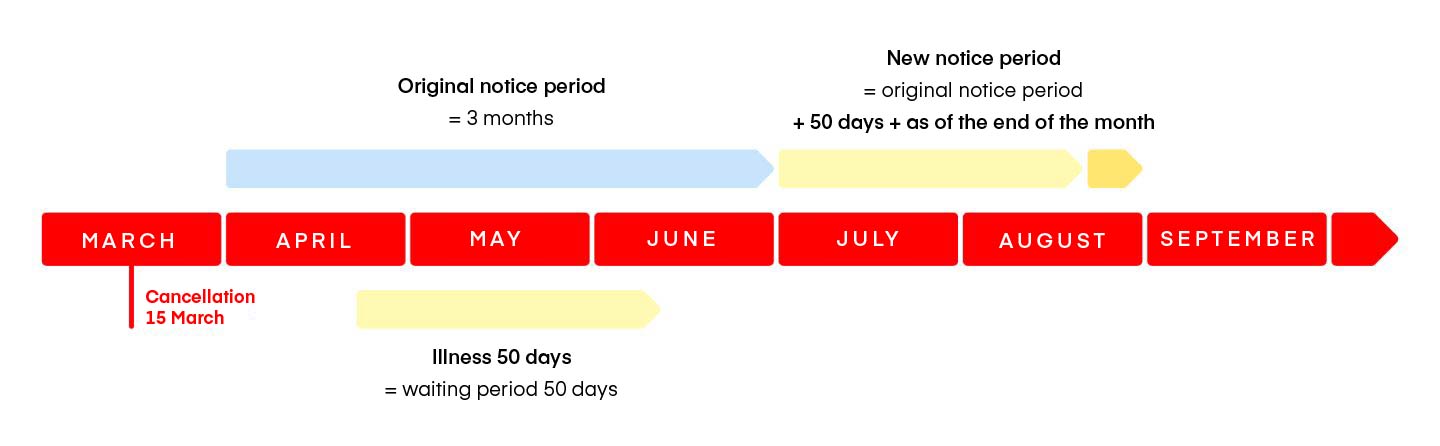
In mid-March, a company gives notice to long-serving staff member Jane Sample with effect from the end of June, in accordance with the normal three-month notice period. During the normal notice period, Jane Sample falls ill for a prolonged period of 50 days. The notice period is therefore suspended for the duration of her illness. Termination therefore takes effect only at the end of August, as the notice period is extended by the 50 days of incapacity to work and termination has to take place at the end of a month.
Effective notice period
It is important to note that proscribed periods are only relevant within the effective notice period. Employers often give notice days or weeks in advance, rather than wait until the last day of the month. This is because the notice period does not begin when notice is given (on 15 March in this example) but only on the next possible notice date, which in this case is the 1st of April.
This also means that if a staff member falls ill on 16 March for ten days, then returns to work, this absence from work does not result in extension of the notice period. Thus, the notice period begins on 1 April and ends three months later with termination of the employment relationship.
When is there no proscribed period?
The intended legal purpose of the proscribed period is to give employees the opportunity to seek a new job throughout their full three-month notice period. However, the law also provides for certain limitations to employee protection. In particular, the rules on proscribed periods do not apply in the following situations:
In fixed-term employment relationships
- Upon termination by the employee
- During a probation period
- Upon dismissal without notice
- Upon termination by mutual agreement
Moreover, if the maximum proscribed period ends and the protected circumstances, e.g. illness, continue beyond 30, 90 or 180 days respectively, depending on the case, then notice of termination can be issued – even, for instance, in cases of illness, if the illness continues beyond the end of the proscribed period.
Additional aspects of the rules on proscribed periods
- Cumulative effect
Different circumstances can trigger multiple proscribed periods if they are unrelated. Military service and a subsequent illness each entail a separate proscribed period.
- Overlapping
If two different proscribed periods overlap, such as when an accident coincides with a pregnancy, for example, the longer proscribed period applies.
- Partial incapacity to work
Partial incapacity to work caused by an illness or accident also triggers a proscribed period and provides protection against dismissal. The period is calculated without taking the degree of incapacity to work into account: 50% incapacity to work results in a full day of protection against dismissal.
This article shows that issues surrounding dismissals and proscribed periods can lead to complex situations, and are not always easily resolved. Each specific case must be assessed and evaluated separately.