Here we use examples to explain all the information in your benefits statement.
Notes on your outpatient benefits statement (in German)
Notes on your inpatient benefits statement (in German)
Here we use an example to explain all the information in your premium invoice.
This is what your premium invoice looks like (in German)
The law expects holders of basic insurance in Switzerland to make a contribution to their own health costs. This contribution is known as out-of-pocket expenses. These comprise a fixed annual amount made up of the deductible and retention fee.
How do out-of-pocket expenses (deductible and retention fee) work?
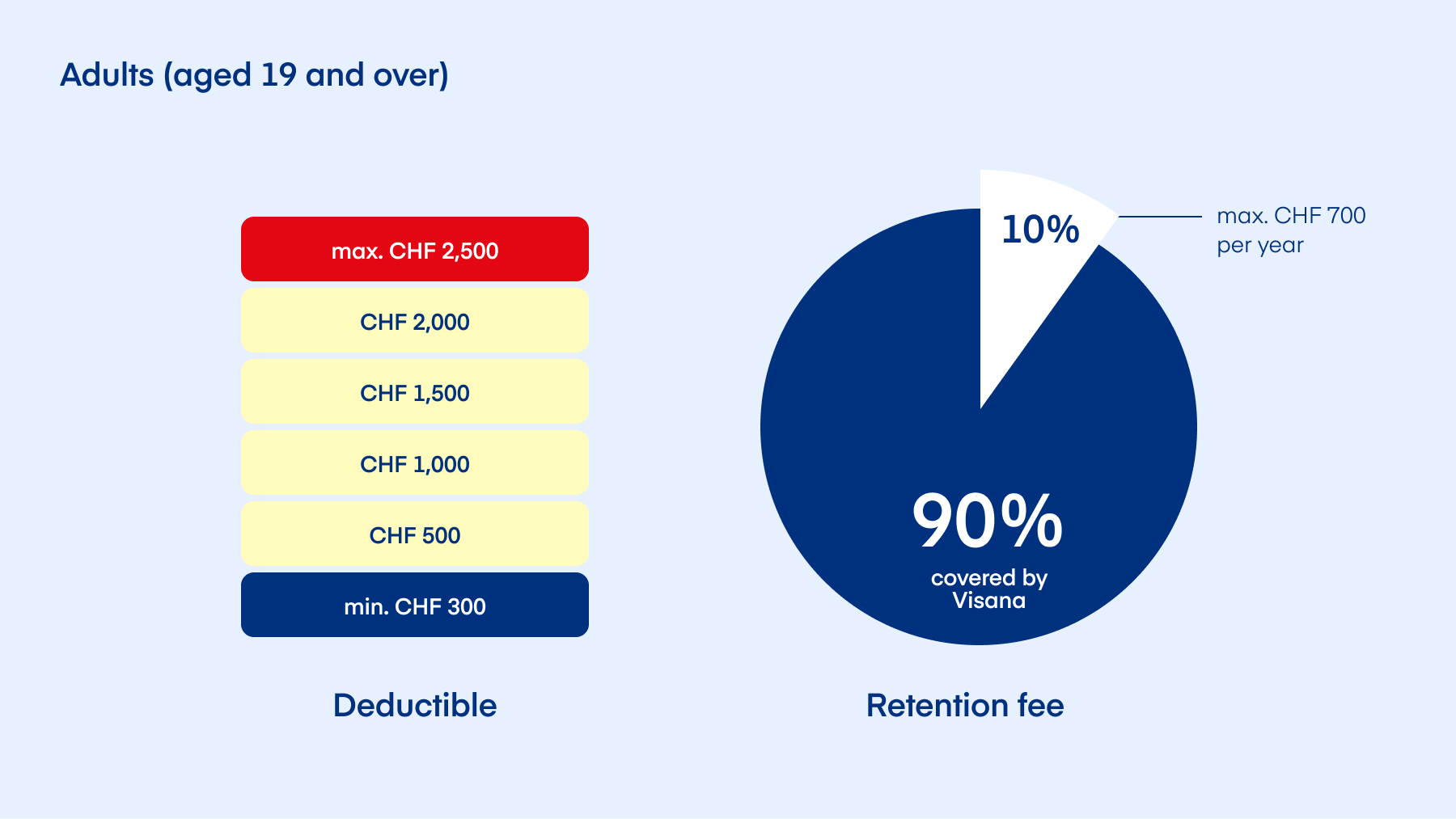
In accordance with statutory provisions, we invoice you for your annual deductible. This is either the standard deductible of CHF 300 or an amount you have chosen yourself up to a maximum of CHF 2,500. You also pay a 10% retention fee in each case up to a maximum of CHF 700 per year. Please note that the retention fee for branded preparations that are interchangeable with generics or biosimilars is 40%.
How much are the maximum out-of-pocket expenses?
Assuming the standard deductible of CHF 300 and the maximum annual retention fee, the maximum out-of-pocket expenses for adults in this case are CHF 1,000. If you choose a deductible of CHF 2,500, the corresponding maximum out-of-pocket expenses are CHF 3,200. In other words, a higher annual deductible increases your financial risk if you fall ill. In return, you can reduce your premium. Provided you comply with the applicable notice period to the end of the calendar year, you can increase or decrease your deductible for the coming year.
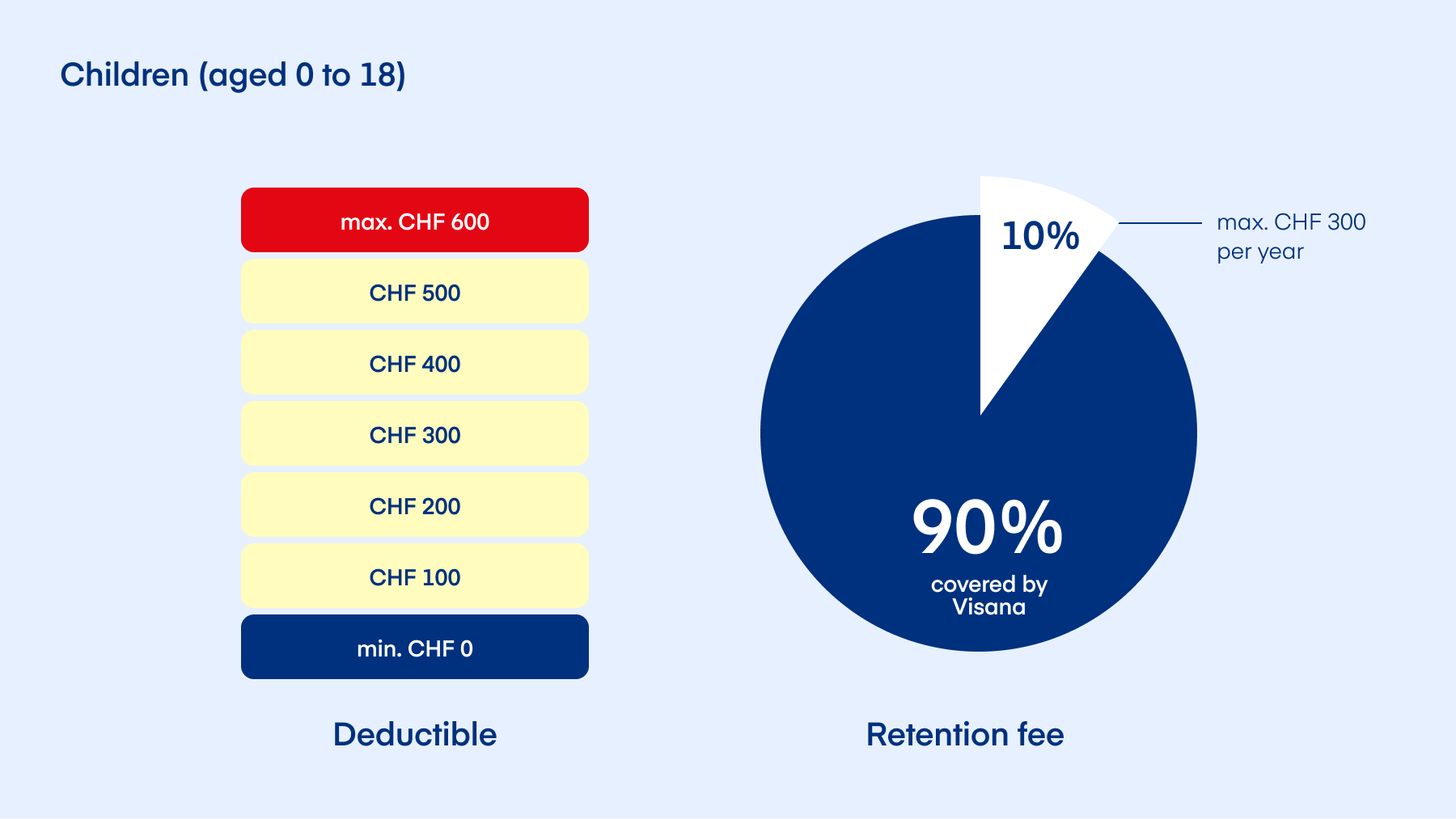
Children and young people under the age of 18 can be insured without a deductible. Your contribution to their healthcare costs is limited to the retention fee, which is capped at CHF 350 a year. You can also choose a deductible of up to CHF 600 for children and young people. With this highest possible deductible, your maximum out-of-pocket expenses will be CHF 950 a year.
What happens if I am hospitalised and what is the “hospital contribution”?
Hospitalisation is covered by basic insurance and is thus subject to statutory out-of-pocket expenses. That means that, as explained above, you will be charged a deductible and retention fee if you are hospitalised. Furthermore, you will be charged a hospital contribution if you are admitted for inpatient treatment. This hospital contribution is CHF 15 per day.
When you take out top-up insurance for the first time or increase your existing cover, a risk assessment is carried out to determine the medical insurance risk.
This is performed using the information in your health declaration, which constitutes part of your insurance application.
If it is in the interests of the whole risk-bearing community, Visana can exclude existing conditions and/or predispositions from the cover it provides, refuse to enter into a contract or, depending on the product, demand a premium supplement.
If you fail to complete your insurance application truthfully and completely, you risk losing your insurance protection retroactively.
The insurance ends in accordance with the Swiss laws HIA/KVG and IPA/VVG. Notice is valid only if served in good time and in writing. Your notice of cancellation is deemed to have been given in good time if received by Visana no later than the last working day before the start of the notice period.
| Insurance class | Notice period | Withdrawal date |
|---|---|---|
| Compulsory health insurance with statutory annual deductible of CHF 300 | 3 months 1 month | 30 June 31 December |
| Compulsory health insurance with selectable annual deductible of CHF 500, CHF 1,000, CHF 1,500, CHF 2,000 or CHF 2,500 | 1 month | |
| Bonus basic insurance | 31 December | |
| Top-up insurance: Outpatient, Complementary, Hospital, hospital daily allowance, home and long-term nursing, dental treatment | 3 months | 31 December |
| Voluntary daily allowance insurance under the Health Insurance Act (HIA/KVG) | 3 months | 30 June/31 December |
| Individual daily allowance insurance under the Insurance Policies Act (IPA/VVG) | 3 months | 31 December |
| Agricultural daily allowance insurance | 3 months | 30 June/31 December |
| Managed Care basic insurance (compulsory health insurance) | 1 month | 31 December |
| Managed Care top-up insurance | 3 months | 31 December |
| Lump-sum accident insurance (LAI/TUP) | None | At the end of the quarter |
| Death benefit | None | At the end of the next month |
| Directa household contents and buildings insurance | 3 months | When the contract ends |
Top-up insurance products are subject to extraordinary notice periods if premiums are increased:
| Insurance class | Notice period | Withdrawal date |
|---|---|---|
| Top-up insurance: Outpatient, Complementary, Hospital | None | On expiry |
| Individual daily allowance insurance under the Insurance Policies Act (IPA/VVG) | None | On expiry |
| Agricultural daily allowance insurance | None | On expiry |
Health insurance premiums reflect constantly rising healthcare costs. We use products such as managed care models or strict invoice controls to actively counteract this trend.
Premium adjustments for top-up insurance plans
In almost all top-up insurance products, the tariff is set according to age, using five-year increments, and reflects the costs incurred. In other words, you change age group every five years and do so for the final time when you reach the age of 70.
Age groups
Age: 00–18 / 19–25 / 26–30 / 31–35 / 36–40 / 41–45 / 46–50 / 51–55 / 56–60 / 61–65 / 66–70 / 71 and over
Any change of age group takes effect on 1 January in the year in which you reach the corresponding age to change group. Should you be affected by an increase in premium, you have the option of terminating the top-up insurance plans in question with effect from the end of the year.
In addition to compulsory basic insurance, you have the option to take out top-up insurance. Legally, the two types of insurance are independent of each other.
We will be happy to explain the advantages of our top-up insurance plans – for hospitalisation, outpatient treatment or travel abroad, for example – in a one-to-one discussion.
One of the most popular ways of saving money is incorporating or increasing out-of-pocket expenses in top-up insurance. We also reward you with additional discounts when you take responsibility for yourself or become a loyal customer.
You can find details of how you can save money on the Savings page or at your agency.
Our agencies and customer service will be glad to help you.
Please be aware that outstanding premiums or out-of-pocket expenses may result in the suspension of benefit payments.
Once the deadline for payment has passed, you will receive a payment reminder. Should your premiums or out-of-pocket expenses remain unpaid, we will send you a payment request. The payment reminder incurs a fee of CHF 5 and the payment request for outstanding amounts from compulsory health insurance under the Health Insurance Act (HIA/KVG) incurs a fee of CHF 50. The fee for the payment reminder for outstanding amounts from top-up insurance under the Insurance Policies Act IPA/VVG is CHF 10.
Should the payment deadline pass without payment being received, the following will apply:
- We use debt enforcement proceedings to recover outstanding amounts from compulsory health insurance under HIA/KVG in accordance with Article 64a HIA/KVG.
- As regards top-up insurance plans, our duty to pay benefits will be suspended until all outstanding amounts have been paid in full in accordance with IPA/VVG. You cannot retroactively claim benefits for the period.
- Within two months of the expiry of the payment period, Visana has the choice of either initiating debt enforcement proceedings to recover the amounts outstanding from top-up insurance in accordance with IPA/VVG or of withdrawing from the contract and waiving payment of the premiums in arrears. Unless Visana has taken action to recover the amounts due or withdrawn from the contract, the contract will automatically lapse when the two-month period specified in Article 21 IPA/VVG expires.
If you work at least eight hours a week, you are covered for occupational and non-occupational accidents under the Accident Insurance Act (AIA/UVG). You have the option of excluding non-occupational accident cover from your basic health insurance.
Working eight hours a week for an employer is enough to cover you against both occupational and non-occupational accidents under the Accident Insurance Act (AIA/UVG). However, if you are either unemployed or are contracted to work less than eight hours a week, you must take out accident insurance with your health insurance fund. In this case, you are not insured under AIA/UVG, but under the Health Insurance Act (HIA/KVG). The most important differences are explained below:
Medical costs
AIA/UVG: Your accident insurance pays the costs of outpatient and inpatient treatment. If you require treatment in a hospital, you are covered for a general ward only. There is no deductible or retention fee. Depending on your marital status and family situation, there may be a deduction for food expenses if you require inpatient treatment.
HIA/KVG: Your health insurance fund also pays the costs of outpatient and inpatient treatment and will invoice you for the deductible and retention fee. The retention fee is 10% and the deductible is at least CHF 300 a year. However, the maximum retention fee is limited to CHF 700 per calendar year.
Daily allowance
AIA/UVG: In the event of full incapacity to work, your accident insurance will pay a daily allowance equal to 80% of your insured salary from the third day. The maximum insured salary is currently CHF 126,000. The daily allowance will be paid to your employer for as long as it continues to pay your salary.
HIA/KVG: There is no entitlement to a daily allowance. Instead, invalidity insurance (IV) pays daily allowances to supplement rehabilitation measures. Anyone who is unable to take part in rehabilitation measures for health or other reasons is not entitled to a daily allowance from IV.
Invalidity pension
AIA/UVG: In the event of full incapacity to earn an income, your accident insurance will pay a lifelong invalidity pension equal to 80% of your insured salary. Since the maximum insured salary is CHF 126,000, the maximum pension is CHF 100,800 a year. If the insured person is also entitled to a pension from IV, the total pension benefits received must not exceed 90% of the insured salary.
HIA/KVG: The health insurance fund will not pay an IV pension for accidents. The insured person must make do with IV benefits. The maximum IV pension is the same as the maximum OASI/AHV pension (currently CHF 2,340 a month). The waiting period is one year. Recipients of an IV pension who do not also receive a pension fund pension are frequently reliant on supplementary benefits.
Death benefits
AIA/UVG: In the event of death, a pension is paid to widows, widowers, children and even divorced spouses. The pension is calculated as a percentage of the insured salary. Widows receive 40% of the deceased’s insured salary, up to a maximum of CHF 50,400 a year.
HIA/KVG: No death benefits.
Integrity allowance
AIA/UVG: Following a serious accident with lasting consequences (loss of a limb, for example), accident insurance will pay an integrity allowance.
HIA/KVG: No integrity allowance.
You can find advice on all questions associated with health and accident insurance from your local agency.
Outstanding premiums, out-of-pocket expenses statements and other amounts in arrears are collected by Visana Services AG’s Collections & Disbursements department in Bern. We issue over one million reminders and payment requests a year. The associated costs are invoiced as follows in accordance with the costs-by-cause principle:
- Payment reminder: CHF 5
- Payment request for compulsory health insurance under the Health Insurance Act (HIA/KVG): CHF 50
- Payment request for top-up insurance under the Insurance Policies Act (IPA/VVG): CHF 10
Legally compliant collection
If the claim remains outstanding, Visana will initiate legally compliant collection (debt enforcement proceedings). The costs are based on the outstanding amount.
| Amount of claim in CHF | Processing costs in CHF |
|---|---|
| 0 to 249.95 | 25 |
| 250 to 499.95 | 50 |
| 500 to 999.95 | 100 |
| 1,000 to 1,499.95 | 150 |
| 1,500 to 2,499.95 | 200 |
| 2,500 to 5,999.95 | 250 |
| 6,000 to 9,999.95 | 300 |
| 10,000 and over | 350 |
Account statements
| Period | Cost in CHF |
|---|---|
| Current and previous year | Free |
| Current year minus 2 or 3 years | 30 |
| Current year minus 4 or more years | 50 |
Paying invoices
Always quote your reference number. To save time, you can use eBill or the banks’ LSV+ direct debit system or PostFinance’s Swiss Direct Debit instead of a pay-in slip.
Financial hardship?
Our Collections & Disbursements department will help you find a solution that is satisfactory for both parties. It is possible to pay off the outstanding amount in instalments. Since we apply a surcharge of CHF 5 per instalment, the fee for a maximum 24 monthly instalments is CHF 120.
| Interval | Due date | Discount |
|---|---|---|
| Monthly | 1st day of the month for which the premium is due | - |
| Every two months | 1st day of the first month for which the premium is due | - |
| Quarterly | On 1 January | - |
| On 1 April | - | |
| On 1 July | - | |
| On 1 October | - | |
| Every six months | On 1 January and 1 July or | 1% |
| On 1 March and 1 September | - | |
| Annually | On 1 January | 2% |
| On 1 March | - |
| Payment method | Explanation | Procedure |
|---|---|---|
| eBill | Your invoices are sent straight to your online banking account, where you can pay them with just a few clicks. | You can register for Visana eBill in your online banking account. |
| QR-bill (pay-in slip with a QR code) | A QR-bill is always enclosed with each invoice you receive from Visana. | You can pay quickly and easily using your online banking account. |
| LSV+ direct debit (banks) and Swiss Direct Debit (PostFinance) |
| Just complete the appropriate payment authorisation (LSV+ or Direct Debit) and send it to the address provided. |
| Standing order | Recurring fixed-amount payments (premiums) are made automatically. | Contact your bank or PostFinance. |
You can change details of your insurance (e.g. deductible or accident cover) yourself in just a few steps using the myVisana customer portal or the Visana app.
If you do not have access to the customer portal or Visana app, just use our form to request changes.
Fees are due if you pay your premiums or out-of-pocket expenses in a post office or other physical Swiss Post outlet. Swiss Post invoices Visana for these amounts. From 1 January 2024, we pass these costs on to you.
You can find how much you will have to pay in fees and other information on the PostFinance website.
You can avoid these fees in the future by switching to one of the payment methods below at an early stage.
| Payment method | Explanation | Procedure |
|---|---|---|
| eBill | Your invoices are sent straight to your online banking account, where you can pay them with just a few clicks. | Register for Visana eBill in your online banking account. |
| LSV+ direct debit (banks) and Swiss DirectDebit Debit (PostFinance) | Amounts due are debited straight from your account. This enables you to pay your invoices simply and with minimum effort. You have a guaranteed 30-day right to object. | Just complete the appropriate payment authorisation (LSV+ or Direct Debit) and send it to the address provided. |
| Online banking | You can pay quickly and easily using online banking. | Just scan the QR-bill with your smartphone or webcam. Enter the recipient and amount. Confirm the payment. |
| Payment order | Send your payment receipts by post to PostFinance or your bank. They will make the payment for you. | Details can be obtained directly from PostFinance or your bank. Please note that you may be charged fees for this method of payment. |